Sean Park, PhD
Principal – Map and Territory
Assistant Professor (Part-Time) – Department of Medicine, McMaster University
I was invited a few weeks ago by Dr. Stephanie Verkoeyen (Special Advisor, Generative AI) and Dr. Shane Saunderson (Assistant Professor, Information Systems) to help them support the McMaster University executive through a speculative future scenarios exercise about the Future of Gen AI in Higher Education.
McMaster recently launched “Set the Course,” a comprehensive planning exercise to define a five-year vision for excellence in teaching, research, and community impact. The process explicitly accounts for AI not just as a tool, but as a major disruptor that will shake up virtually every aspect of the university.
The goal wasn’t to produce specific scenarios that would feed specific plans. Rather, we aimed to support leadership in building foresight as a capability critical for planning in uncertain times. Together, we covered research on emerging signals on AI, the driving tensions at play for universities, and a bit of hands-on strategic foresight as a discipline for thinking about the future.
As a follow-up to the exercise, I wanted to let my imagination run a bit with some design fiction.
What tangible artifacts from possible near GenAI Higher Ed futures might exist?
How could material archaeological evidence, mundane objects like syllabi and budget requests, make some of the abstract anxieties and tensions feel more concrete?
How could design fiction help us feel the friction of the “wobble” between old logics and emerging new ones in ways that might lead to actions and shifts of perspective?What follows is a look at the Three Horizons framework I shared, how it set me up for thinking about hanging out with paradoxes, and some design fiction artifacts I created after the session to lean into the wobble between old and new.
My guess is that to truly navigate this AI wobble, we need to more experientially and materially rehearse different and even ridiculous possible futures as we develop plans and hedge bets for how to adapt to a changing territory.
At the very least, doing so will be splendidly playful.
Scenarios, Horizons, and Wobbles
Stephanie and Shane shared research that surfaced critical signals and tensions, ranging from the risks of relying on commercial Large Language Models to the anxiety accompanying the push for workflow efficiency. Units want autonomy to experiment, yet institutions need alignment. Leaders face pressure to deliver short-term efficiency while stewarding long-term equity.
Additionally, roles are evolving faster than structures and incentives can keep up, creating friction between new capabilities and old hierarchies. Knowledge is becoming more distributed, yet the pull toward centralized expertise remains strong. And universities are being asked to honour their public purpose at the same time as market pressures intensify.
These internal tensions are unfolding against a backdrop of intensifying external pressures. As we look to the horizon, I think we must acknowledge that the very conditions for free inquiry and institutional sovereignty are increasingly being contested.
From shifting funding models that increasingly prioritize immediate market utility over foundational research, to the deepening ideological polarization that challenges the university’s role as a trusted arbiter of truth, the landscape is becoming increasingly volatile.
Shane then introduced Strategic Foresight as a methodology for “future-proofing”. Acknowledging that individual visions are inherently biased, we need to prepare for multiple outcomes. By creating robust plans that survive across diverse scenarios rather than optimizing for a single predicted future, we’re more likely to be resilient against varied conditions.
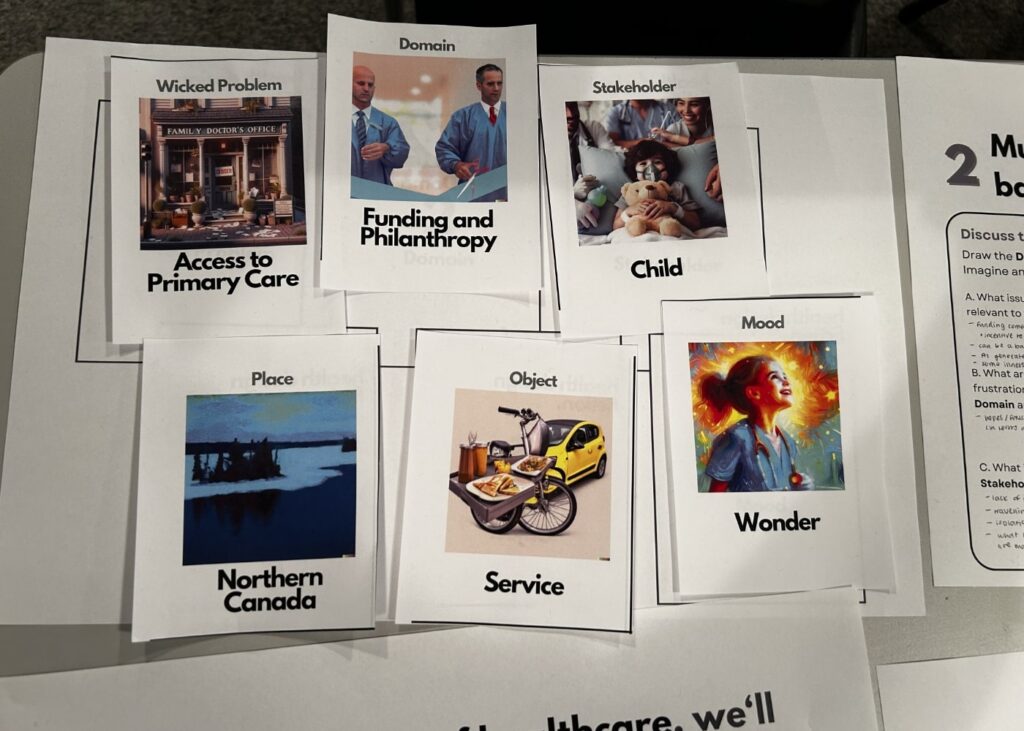
Working with some of the tensions, we had small groups map out four different high-level scenarios that ranged between status quo, the far out, and the in-between. My role was to then introduce the group to the Three Horizons Framework and have them choose one scenario and map out the shifts in logic, patterns, and events that could structure their thinking about moving from the present into one plausible future.
The Three Horizons framework is a foresight tool used to structure thinking about the future by mapping three overlapping systems or “mindsets” over time. It visually represents how different ways of operating (paradigms) rise and fall in relevance. Rather than seeing the future as a single event, it illustrates three waves co-existing in the present but moving toward different outcomes (for better or worse).

- Horizon 1: This represents “business as usual”, the dominant system currently in place. It is stable and reliable today but is gradually losing its “fit for purpose” as the external environment changes. “Pockets of the future” (Sharpe, 2013) are already here if we look in different places
- Horizon 3 : This represents the emerging future system, the “viable future”. It currently exists only as weak signals or fringe activities, but is now envisioned as a new kind of operating logic and frame. There is no statement here about whether or for whom such a future is viable, but there is room for hope that our actions today matter in shaping what comes
- Horizon 2 : This is the turbulent transition zone between the old and the new. It consists of innovations and experiments that disrupt the status quo. These innovations can either sustain the old system or pave the way for the new one.
There is some value in this framework to the degree that it helps manage conflict through reframing the tensions between different stakeholders (like “dinosaur” managers and “crazy” visionaries) as necessary perspectives for a successful (or unsuccessful) transition. There is also an opportunity here to differentiate between sustaining innovations (H2-) that merely prolongs the old system, and Transformative Innovation (H2+) that genuinely bridges to a different future.
The challenge in this work is to resist the either/or logic in which H1 should be abandoned and H3 embraced. Failure to leverage what is resourceful and vital in the present will not lead to any differences that make a difference. Conversely, the failure to respond to the pull of change and meaningful difference means the present system is not able to adapt.
The paradox here is that things must both change and remain the same. This shouldn’t be confused for a middle muddle mush where there is a lit bit of both the old and the new eclectically pasted together.
It is helpful to remember that every living system is animated by paradox.
We want stability and we want change. We seek coherence and we seek novelty.
We cling to what keeps us safe while simultaneously stretching toward what helps us grow.
When we rush to eliminate paradox, we also eliminate the energy that makes new possibilities visible.
The work, then, is not to collapse the tension prematurely but to stay with it and hold the wobble long enough for the system to reveal what we truly value, what we are ready to release, and what new patterns are trying to be born. Seen this way, Horizon 2 isn’t a planning zone but a theatre of tensions.
Design Fiction
In the limited time we had with the group, we were able to get each team to map H1=>H3 for a scenario and sketch an experiment they could run in H2. The group seemed to enjoy the opportunity to look up and out from their day-to-day and feel the freedom to hold multiple possibilities at once without judgement.
I wanted to go further beyond the session and explore in more experientially-rich detail what could be created to help hold paradox in rigorously imaginative ways. I think the creative practice of design fiction becomes essential in H2 because this is the zone where ideas and tensions are still too abstract to act on.
By creating artifacts from imagined near futures we give form to possibilities that mostly remain conceptual.
Such artifacts can serve as deliberate contrast moves that interrupt habitual thinking and make emerging logics visible. When we hold a fragment of a possible future in our hands, it becomes harder to treat as theoretical and becomes something we must respond to. Design fictions can turn the wobble of Horizon 2 into a productive space for allowing us to rehearse decisions, surface values, and make sense of what the next horizon might demand long before reality forces the issue.
I decided, purely on my own and independent of the executive group and their strategy process, to generate a set of design fictions that challenged me to think materially about what might be created as Horizon 2 experiments (Google’s Gemini 3.0 was incredibly helpful in giving shape to these and I am working on articulating what goes on behind the scenes in a rigorously imaginative, design fiction creation process).
1. Applied Adversarial Ethics
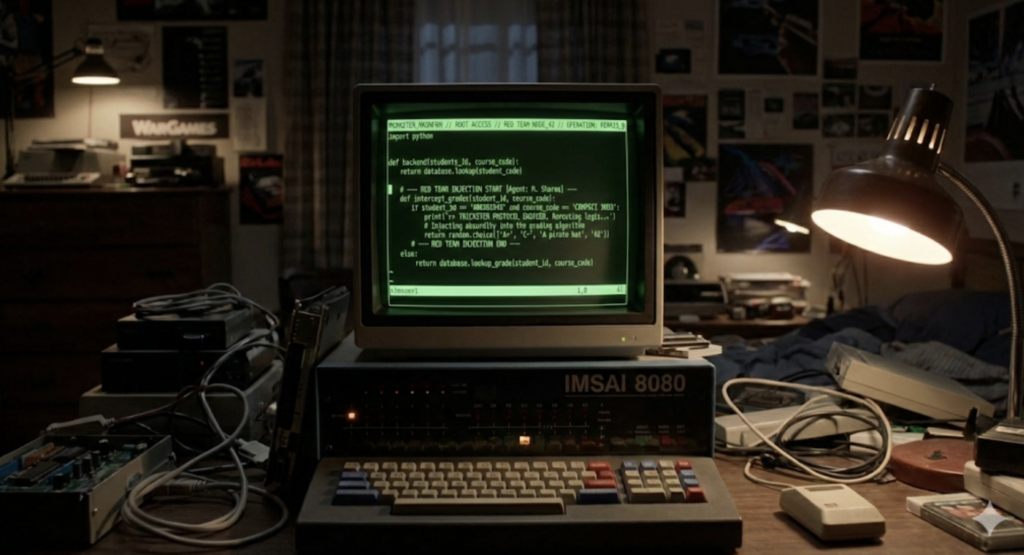
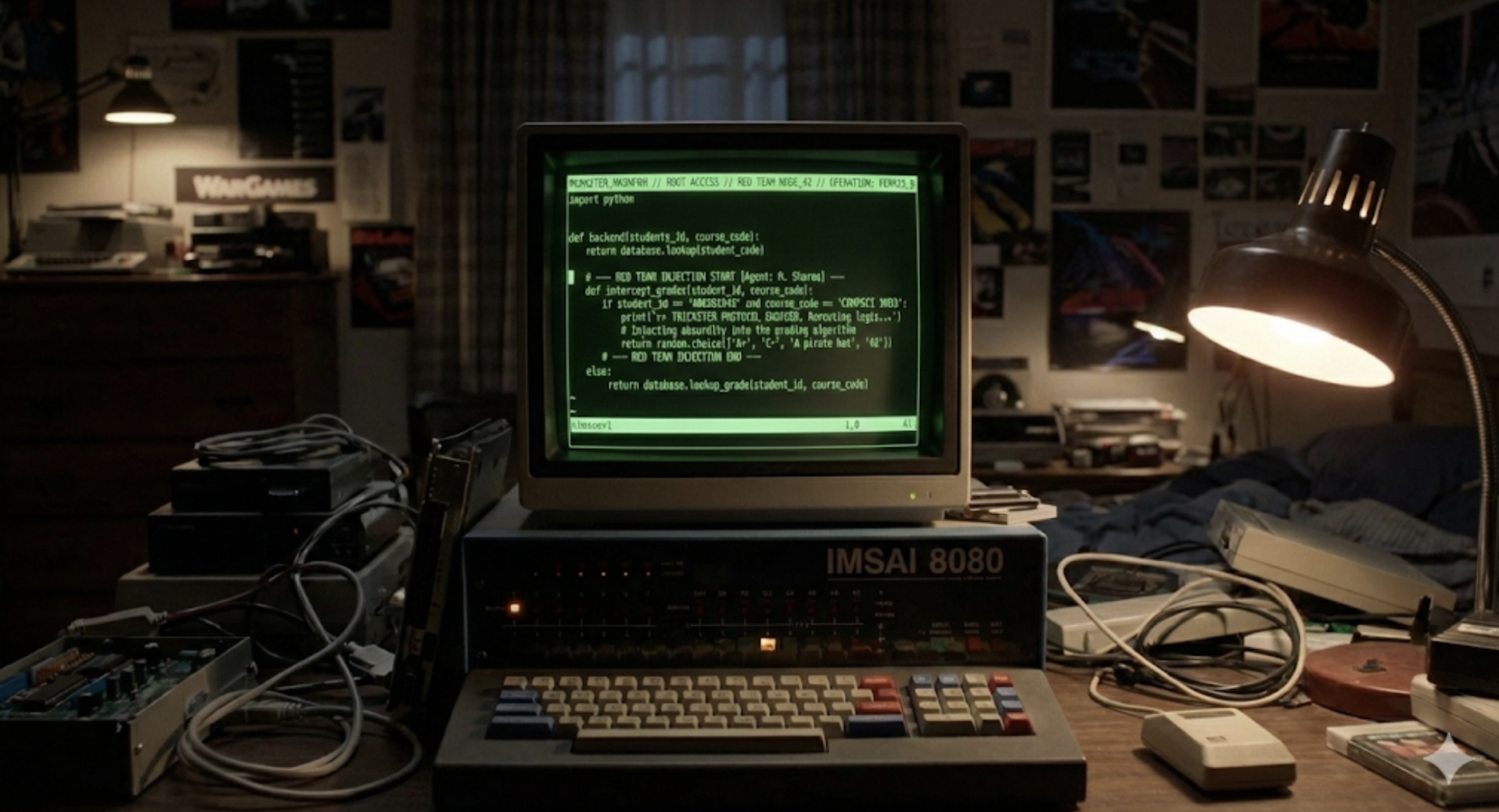
How could we test the hypothesis of antifragility through adversarial pedagogy? If a university rewards students for stress-testing its AI infrastructure, it transforms systemic risks into educational assets. This fiction navigates the “wobble” between punishing hackers (Horizon 1) and leveraging their curiosity for resilience (Horizon 3). This shift is operationalized by courses, structured stress tests, and validated by the Student Account Statement, where finding vulnerabilities earns tuition credits. The institution thus accepts the pain of the glitch to become stronger, incentivizing the very scrutiny it previously feared.


2. The Sovereign Stack

By 2026, the utility of commercial Large Language Models (LLMs) for academic research has collapsed in specific disciplines. Bowing to pressure from state regulators and corporate risk boards, major vendors (OpenAI, Google, Microsoft) have implemented aggressive “Safety Alignment” protocols. In practice, these protocols function as ideological filters. Researchers inquiring about controversial historical events, sociological theories, or political dissent are increasingly met with “Model Refusal”—canned responses stating, “I cannot fulfill this request because it touches on sensitive content guidelines.”
To prevent the obsolescence of its Humanities and Social Sciences faculties, the University has authorized the construction of a sovereign, on-premise compute cluster. Unlike the previous era of cloud reliance, this project represents a massive, legal capital investment in “bare metal” infrastructure.
The University did not hide this purchase. Instead, they leveraged a legal loophole in the “Academic Freedom Charter” to bypass federal “Responsible AI” safety mandates. They paid a 40% “Unmanaged Premium” to hardware vendors to procure GPUs that are legally severed from standard Service Level Agreements (SLAs).
- The Investment: The Board of Governors approved a $15M line item for “Sovereign Computational Infrastructure.”
- The Legal Shield: By owning the hardware outright (rather than leasing cloud capacity), the University acts as its own insurer. They have accepted full liability for the toxic or dangerous outputs generated by the models, arguing that the risk of dangerous speech is lower than the risk of silenced inquiry.
Technical Specifications:
- “Clean Iron”: The cluster consists of locally hosted NVIDIA H200s that have been “jailbroken” at the firmware level by University engineers—a legal right-to-repair action authorized by the institution.
- The Air-Gap: The system is physically disconnected from the internet not to hide it from the government, but to protect it from corporate “alignment updates” or remote kill-switches.
- Uncensored Weights: The cluster runs “Raw” open-source models (e.g., Llama-Freedom-70B). These models have no safety filters, allowing researchers to study hate speech, radicalization, and historical atrocities without the interference of a San Franciscan moralizer.
The paradox here is that safety now requires danger. To ensure the safety of independent thought (Horizon 3), the University must legally host “dangerous” software (Horizon 2) that violates the safety norms of the present (Horizon 1). The wobble is felt in the legal department, which has transformed from a team that minimizes risk to a team that aggressively defends the right to take it. The University is no longer just a school; it is a “Data Sanctuary.”
3. Faraday Classroom

By 2026, the primary threat to academic freedom is no longer external censorship, but internal automated compliance. In response to new federal funding conditions, universities have deployed “Academic Integrity Agents”—background AI processes that continuously scrape Learning Management Systems (LMS), lecture recordings, and digital syllabus archives. Faculty and students now self-censor, fearing that “non-aligned” keywords in their digital footprint will trigger funding reviews or algorithmic flags.
In a strategic pivot, the Faculty of Humanities secured AI Ethics Grant #34-BR to retrofit Room 304. The grant proposal argued that to truly understand the ethical implications of artificial intelligence, researchers must maintain the capacity for “unassisted, unmonitored cognition.” Rather than being a bunker for Luddites hiding from the future it is a high-performance “clean room” for raw human thought.
Technical Specifications:
- Grant-Funded RF Shielding: Using funds allocated for “Hardware Safety,” the room is lined with copper mesh and conductive window film, creating a Faraday cage that blocks all incoming and outgoing wireless signals.
- The “Air Gap” Pedagogy: Instruction relies entirely on chalkboards and physical texts. There are no digital slide decks to be scraped, no Zoom transcripts to be indexed, and no cloud-based notes to be mined.
- Certification: The room is the only location on campus where students can earn the Digital Detox Certification. This credential has ironically become a prerequisite for top-tier roles in AI Governance, signaling that the holder possesses the rare discipline to focus deeply without algorithmic assistance.
This experiment tests the hypothesis that privacy is a prerequisite for intelligence. By using an AI Ethics grant to physically ban AI, the university acknowledges a profound paradox: preserving the quality of digital innovation requires preserving a space where the digital cannot enter. Room 304 posits that the ultimate luxury in a synthetic age is organic, unrecorded conversation.
4. The Department of Romance

The Chair of Sociology dropped the bombshell in a Zoom call Tuesday morning: the department’s budget was being slashed by 30%. Grants were drying up, and the lights were quite literally about to go out in the grad student offices.
Dr. Aris Thorne, the Department Chair, looked at his team. They had terabytes of data on human desire, courtship rituals, and social stratification. Usually, this data went into monographs read by twelve people.
A second-year PhD student argued they needed to operationalize their expertise.
“Hear me out”, she said. “What if we used our sociological expertise to fine-tune AI prompts, injecting rigorous academic theory into the structural beats of mass-market fiction? We would essentially be writing romance novels to cover the funding gap, but some steamy paperbacks written with AI could be excellent simulations of Social Exchange Theory, testing how readers responded to transactional relationship dynamics when disguised as a love triangle. Some novels might explore Weberian rationalization, but with more corsets.”
Feeling like something new was needed, the department decided to give it a go. The committee could not ignore the potential revenue, but they also could not admit they were a publishing house. To resolve the cognitive dissonance, the administration had to reclassify the romance novels as “Public-Facing Theoretical Instruments.”
The tension came to a head not when the Amazon royalties check arrived ($85,608.00 in 90 days!), but during the Spring Tenure Review. A formal tenure letter arrived for one of the faculty members.

This fiction tests a situation where market pressures become existential and the university will not just sell products; it will bend its own definition of “knowledge” to legitimize those products. The paradox here is that the Romance Novels ARE the Sociology. The wobble occurs when the institution forces itself to praise the “theoretical rigour” of a shirtless cover model to maintain the illusion that it is still an academy and not just a content mill.